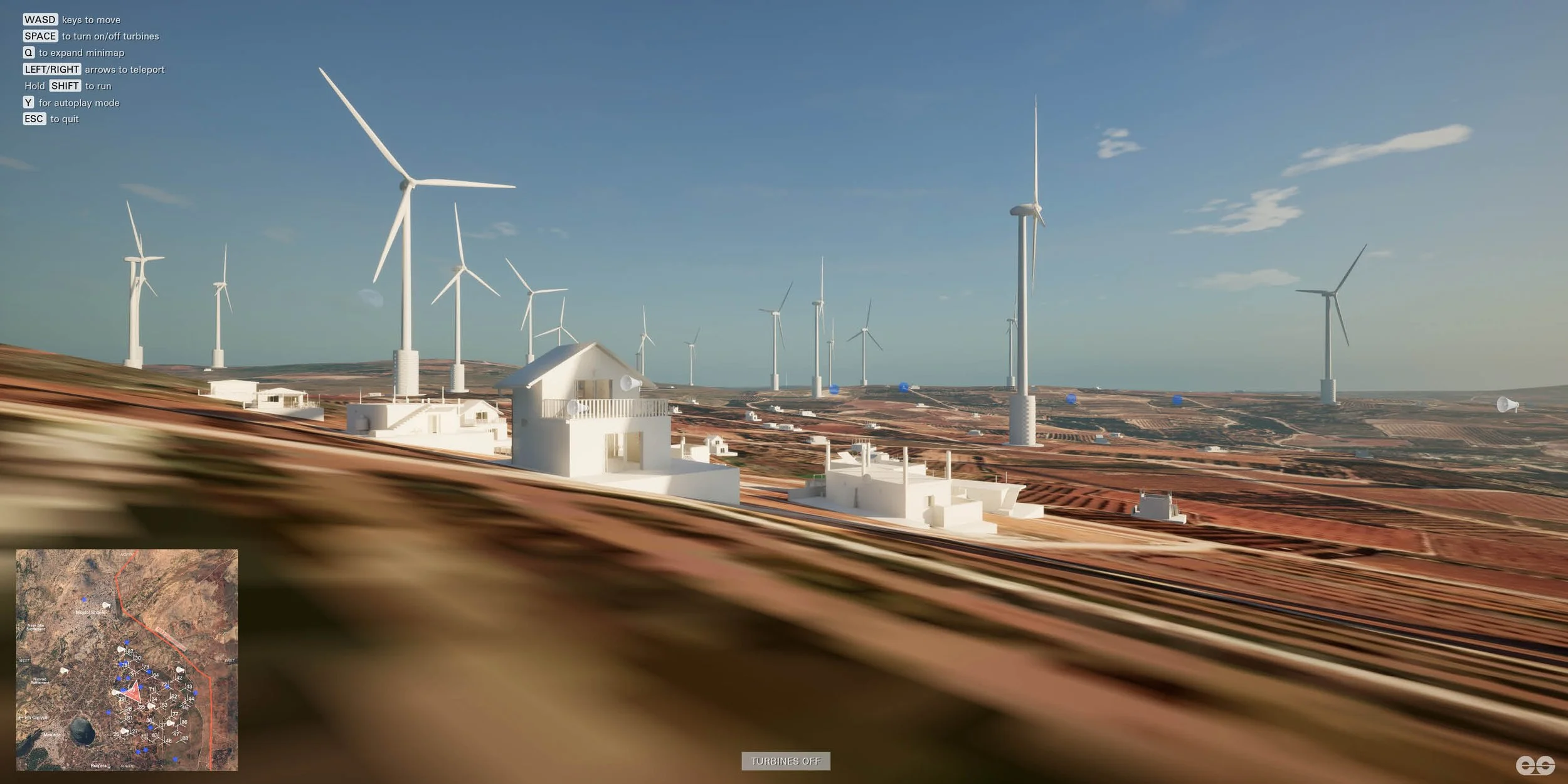
Lawrence Abu Hamdan, ‘Zifzafa: Livestream Audio Essay’ (2025). Video game simulation still. Courtesy of the artist.
The Common Guild presents our second project with Lawrence Abu Hamdan. ‘Zifzafa’ is exhibited for the first time in the UK in collaboration with Edinburgh Art Festival (EAF).
Through his practice of “forensic listening”, artist, sound investigator and founder of Earshot, Lawrence Abu Hamdan creates performance, sound and video works that explore the political force of sonic experience. ‘Zifzafa’ (2025) is Abu Hamdan’s recent body of work comprising of a multichannel audiovisual installation, performance and video game which demonstrates the effects of noise pollution and green colonialism activities in the Israeli occupied Golan Heights, or Jawlan, in south-western Syria.
‘Zifzafa’ is an archaic and sonorous word borrowed from Arabic poetry describing a wind that shakes and rattles everything in its path. Abu Hamdan’s audio investigation, conducted with fellow researchers at Earshot and commissioned by the Arab human rights centre Al Marsad, contests the proposed construction of 31 of the world’s largest land-based wind turbines in the last remaining open space for Jawlani Syrians who since 1967 have faced continuous acts of expropriation and dispossession.
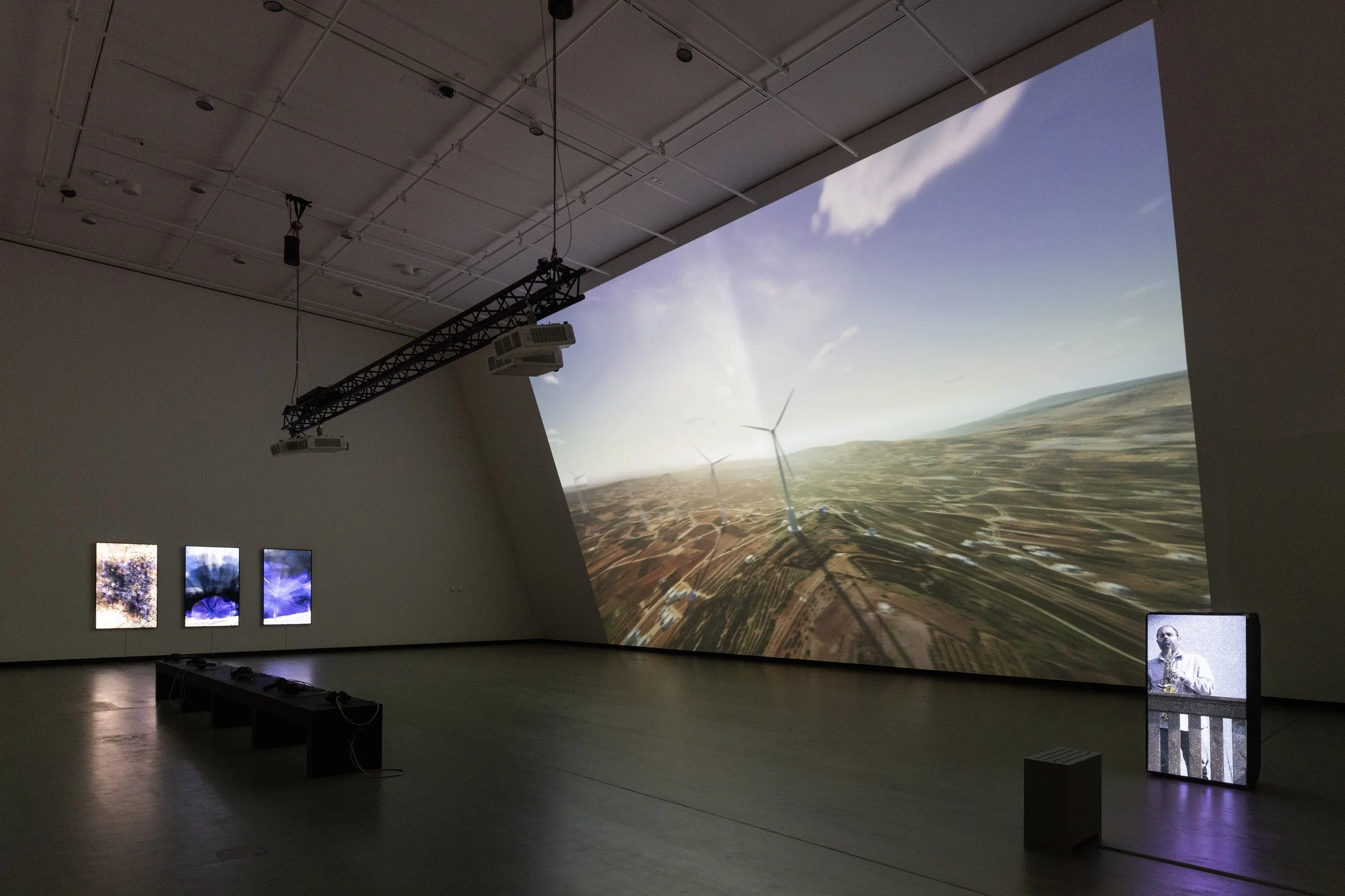
Lawrence Abu Hamdan, ‘Zifzafa’. Installation view. Munchmuseet, Oslo, 2025. Courtesy of the artist. Photo: Ove Kvavik.
Developed over two years within the Golan Heights community, ‘Zifzafa: Livestream Audio Essay’ (2025), features a simulated landscape which illustrates the intense sonic impact of the wind turbines on residents. Proposed as a green energy project, each of the colossal 256 metres tall turbines are anticipated to generate between 70–90dB of noise – an intensity of sound equivalent to a busy highway. Some turbines are planned as close as 35 metres to homes, their sonic footprint rendering the area uninhabitable and effectively enforcing a sonic annexation.
The video digitally maps the sonic footprint of a similar wind farm site, recorded in Germany, across the geography of the Golan Heights. These sounds are met with field recordings of natural and community life captured by Jawlani composer and sound artist Busher Kanj Abu Saleh. Sounds of bees, cows, thunder, saxophones, shovels, weddings, and playing children are inserted into the video using gaming software. The video exists as both a piece of environmental evidence, demonstrating green colonialism in action, and as a record of a soon-to-be past version of the Golan Heights.
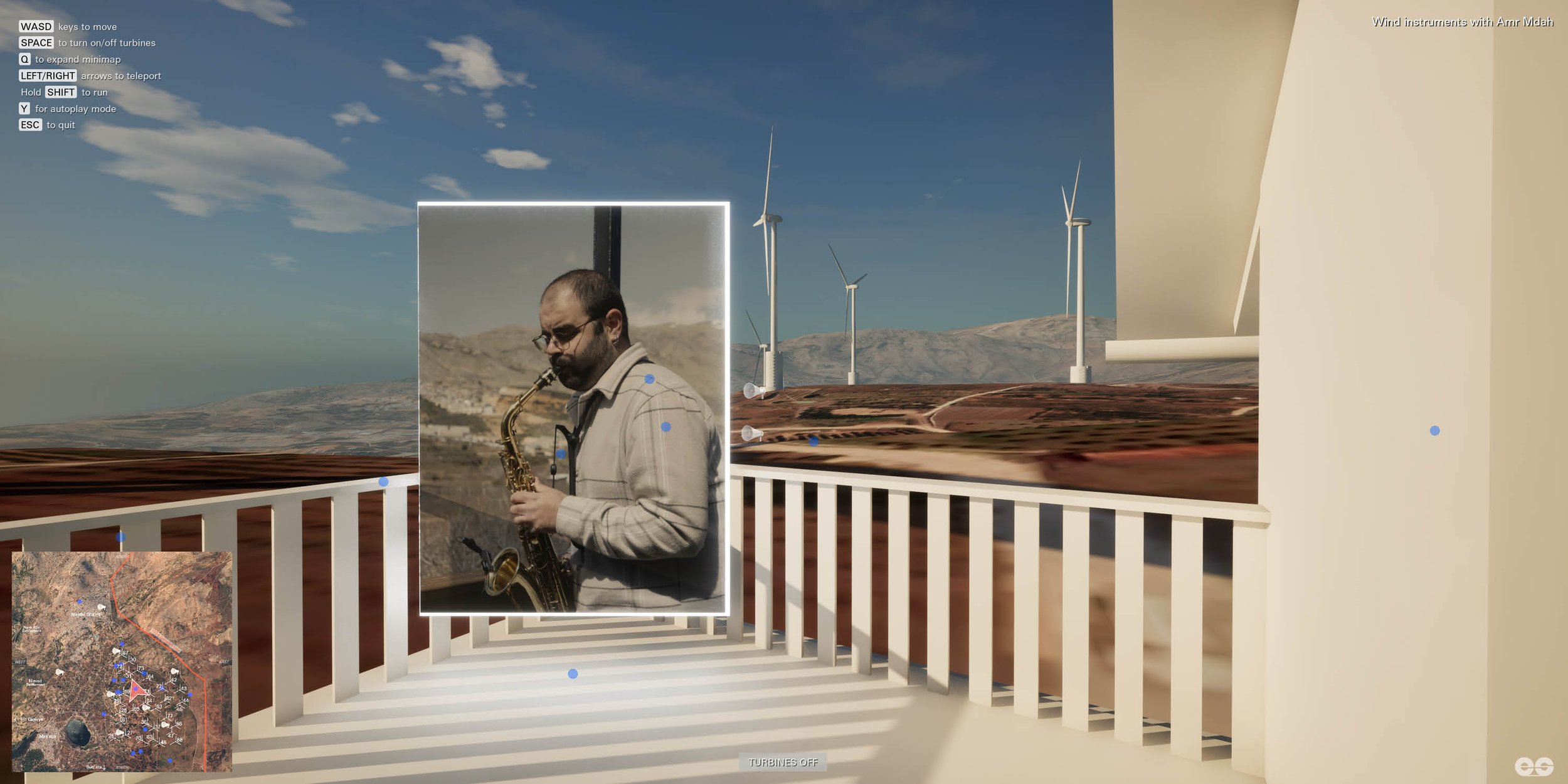
Lawrence Abu Hamdan, ‘Zifzafa: Livestream Audio Essay’ (2025). Video game simulation still. Courtesy of the artist.
‘Wind Ensemble’ (2024) is a video projection onto stacked amps featuring Jawlani musician Amr Mdah performing his own composition for saxophone on a farmhouse balcony. The house on which he is performing will be 50 metres away from one of the proposed turbine sites. Drawn to the relationship between Mdah’s breath and the natural sounds of the Jawlani landscape, Abu Hamdan presents a visually simple, yet stirring, act of sonic defiance.
‘Tilting at Windmills i, ii & iii’ (2024) is a three-channel video whose title refers to the idiom which means to fight enemies who do not really exist. This phrase originally appeared in Miguel de Cervantes’s ‘Don Quixote’ (1615) by as the protagonist charges towards windmills thinking that they are giants. In this defiant image, Abu Hamdan questions the ability to fight against the proposed turbines whilst presenting visualisations of the sound impact the turbines will have on the surrounding landscape.
Live Performance /
On Saturday 29 August, a live performance of ‘Zifzafa’ will be held at Leith Theatre on the closing weekend of EAF26 (14–30 August 2026). The performance is scored by Busher Kanj Abu Saleh, who will perform live together with saxophonist Amr Mdah, both artists from the Golan Heights community, and Renate Lurdesa Baumane an audio investigator from Earshot. The event is programmed in collaboration with EAF, in association with Falastin Film Festival. You can book a ticket via edinburghartfestival.com.
About the artist /
Lawrence Abu Hamdan, the self-described ‘Private Ear’, has over a decade of experience investigating audio on behalf of people under attack from state authorities. He has a doctorate from the University of London on the role of sound in legal investigations, and his investigative work has been used as evidence at the UK Asylum and Immigration Tribunal and in a formal request to the International Criminal Court. In 2023 he founded Earshot the world’s first not-for-profit organisation dedicated to the study of audio for human rights and environmental advocacy.
His work has been presented in the form of forensic reports, lectures and live performances, films, publications, and exhibitions all over the world, including at the 61st and 58th Venice Biennale, MoMA New York, MUAC Mexico, the 22nd Biennale of Sydney, the 11th Gwangju Biennale, the 13th and 14th Sharjah Biennial, the 34th Biennial of São Paulo, Tate Modern, Hammer Museum, Los Angeles, and the Hamburger Bahnhof, Berlin. Abu Hamdan has been widely recognized internationally with awards such as the Grand Prix at Winterthur International Film Festival, the 2020 Toronto Biennial Audience Award, the 2019 Edvard Munch Art Award, which included being given a solo exhibition at MUNCH, Oslo. This was the first presentation of ‘Zifzafa’.
Exhibition Details
Free exhibition
Opening Hours
Thursday–Saturday, 12–5pm
20 August–17 October
Workshop
Saturday 17 October, 1–5pm
Glasgow Library of Synthesized Sound (GLOSS)
5 Florence Street
Glasgow, G5 0YX
Programmed in collaboration with Glasgow Library of Synthesized Sound, sound artist Mathias Arrignon will lead a workshop, entitled ‘Sound-Led Imaginaries for Environmental Remediation’ devised in response to ‘Zifzafa’ which explores the politics of sound and “acoustic enrichment”, a technique using sound diffusion to restore damaged ecosystems.
This event is now fully booked, you can join a waitlist below.
Exhibition Visitor Access
The exhibition takes place on the ground floor of 5 Florence Street.
The building has step free access.
Accessible and gender neutral toilets are available.
The nearest subway station is Bridge Street, a 14 minute walk away.
Download The Exhibition Leaflet
Design by Phoebe Kerr.
Further Info
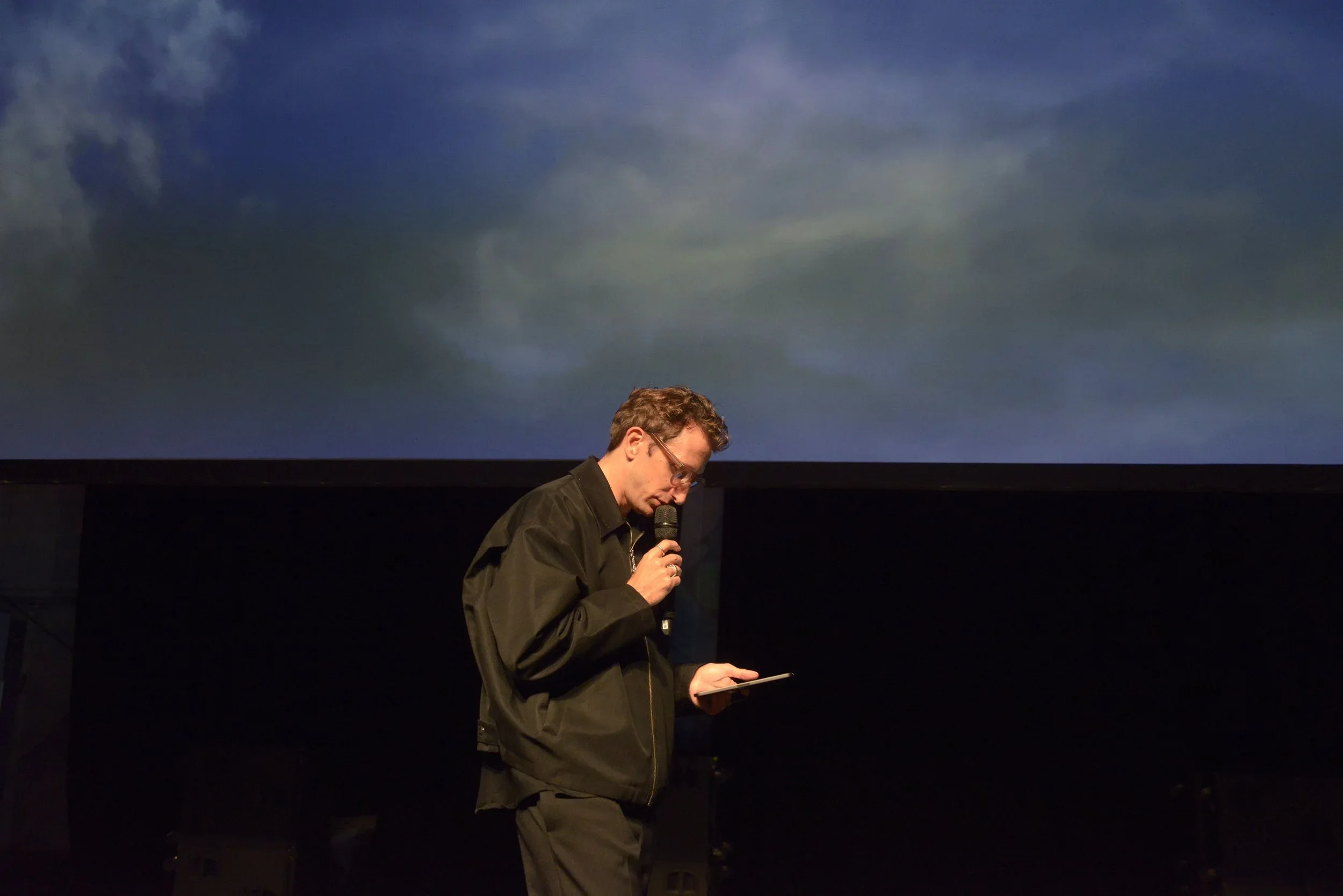
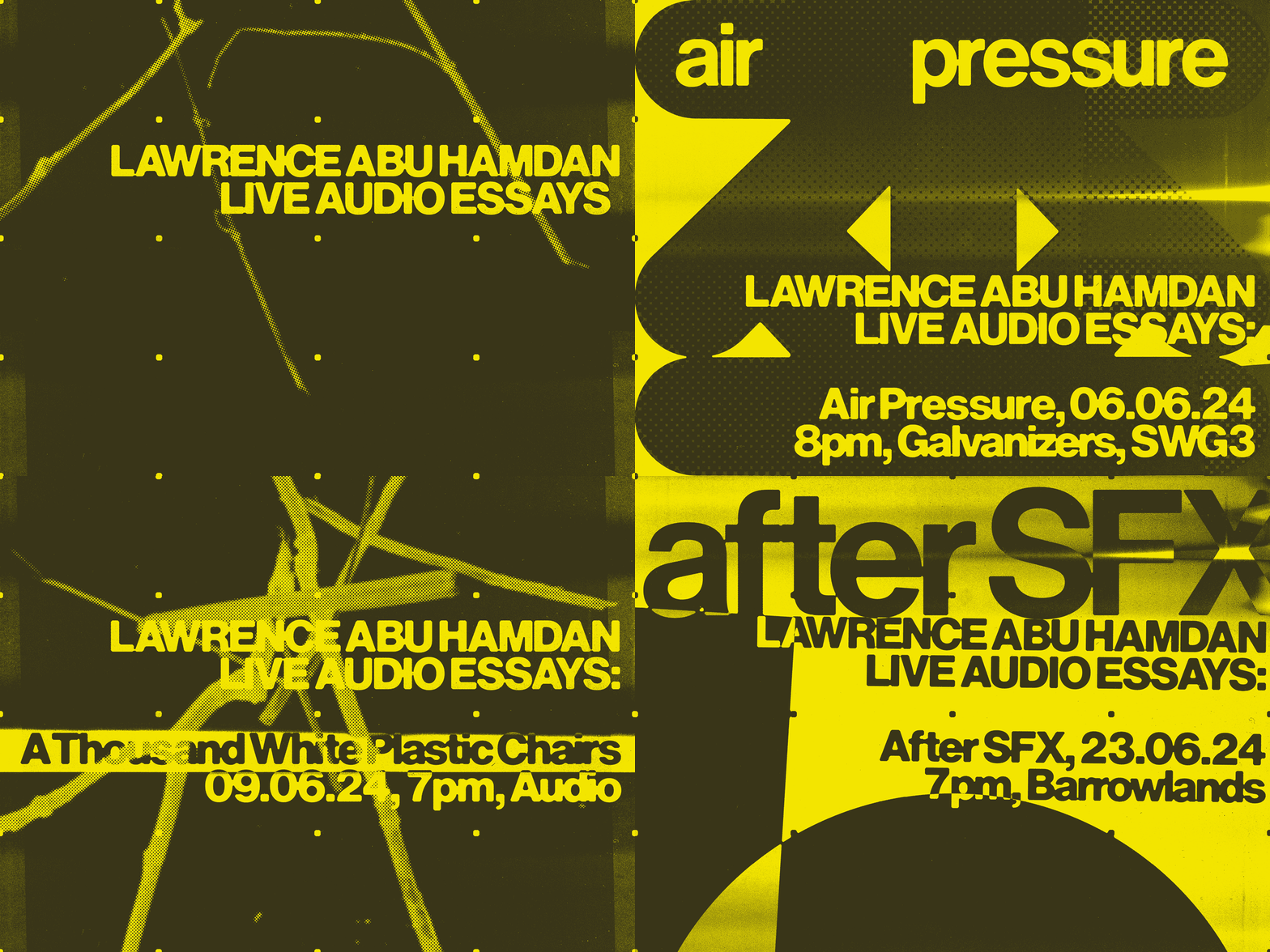
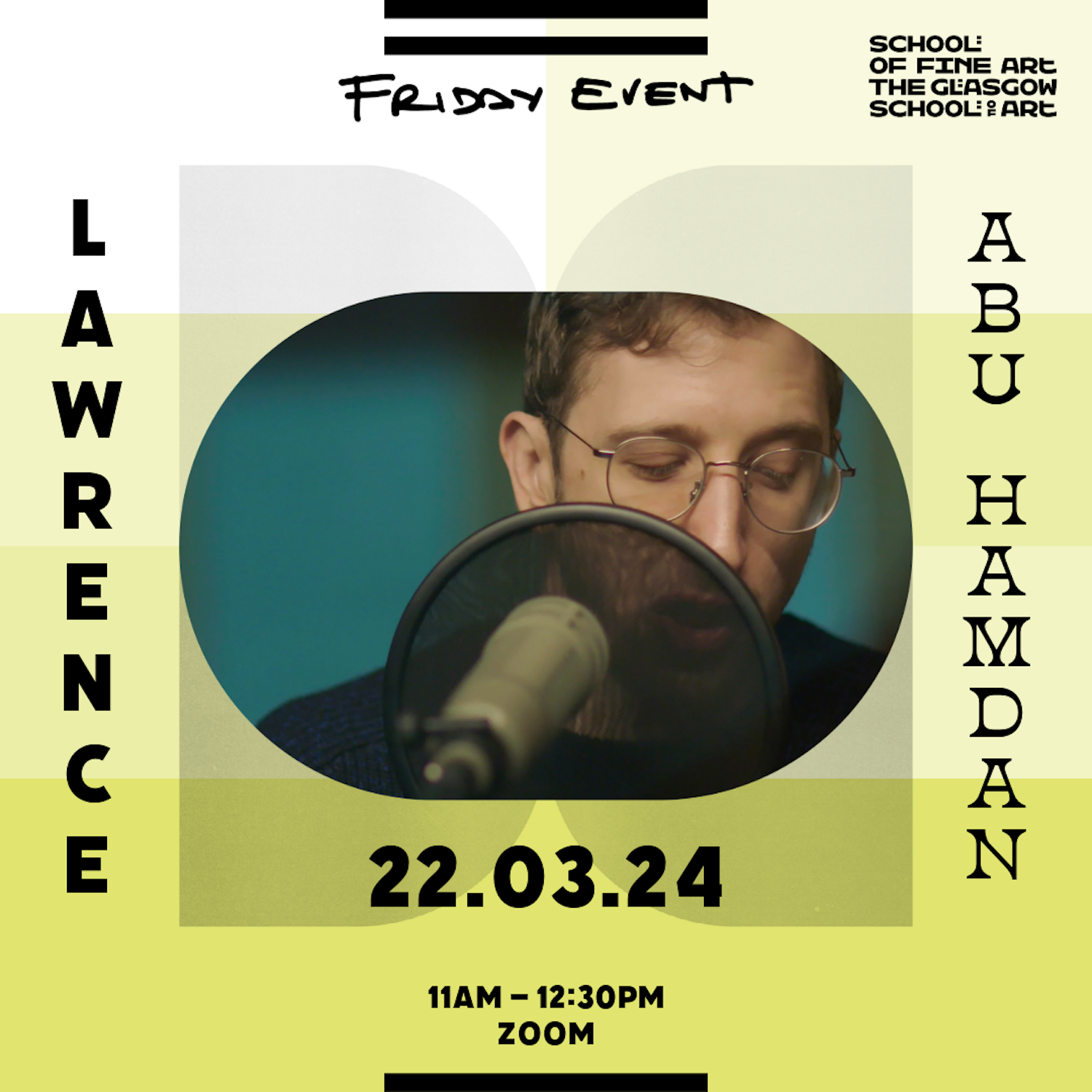
‘Live Audio Essays’ was our first project with Lawrence Abu Hamdan. Part of Glasgow International 2024, the project comprised three key live performances works at venues across Glasgow.
Room for Reading / Lawrence Abu Hamdan
Additional Links
Read the exhibition guide (large print)
Edinburgh Art Festival E-flux | July 2026
Lawrence Abu Hamdan interview | The Guardian | 25 August 2026